
Across the Net: Shifting Your Focus to WinAcross the Net: Den Fokus auf die andere Netzseite richten
Why the most important person on the court isn't you.
You have undoubtedly heard the saying that you are the most important person on the court. That you are your own biggest opponent, and that you need to defeat your own fears and anger first before you can win the match. You have heard coaches say "focus on your game," and you have heard coaches and parents say "don't worry about the win."
I want to fundamentally change the way you think about those statements.
Firstly, when a match is completed, the scoreboard does not show Johnny beat Johnny. It shows that Johnny beat Andy. You beat the person on the other side of the net, NOT YOURSELF. For me, the person on the other side of the net is the single most important person on the court.
The trap of inward attention
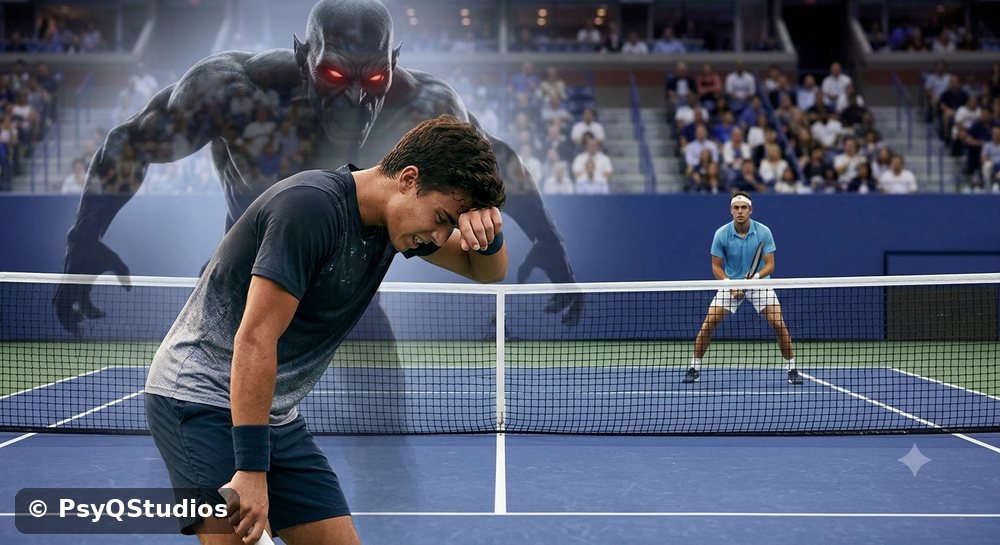
Let me explain what actually happens when you turn inward. When you feel anxious during a match, or angry, sad, or full of apathy, it means your focus is entirely trapped on your side of the net.
Your internal dialogue becomes an endless loop of self-absorption: "I am angry, I am nervous, I am stressed." The focus becomes so consumed with trying to contain your own demons that you completely forget the fundamental task at hand: WHAT DO I NEED TO DO?
Think about it from the opposite perspective. If your opponent gets angry, you feel like you're getting the better of him or her, right? You gain confidence seeing their frustration. The exact same thing happens when you get angry. You disregard what your visible anger does to fuel your opponent's confidence. And why do you miss this? Because your attention is stuck on your side of the net, not theirs.
Training vs. match day: two distinct arenas
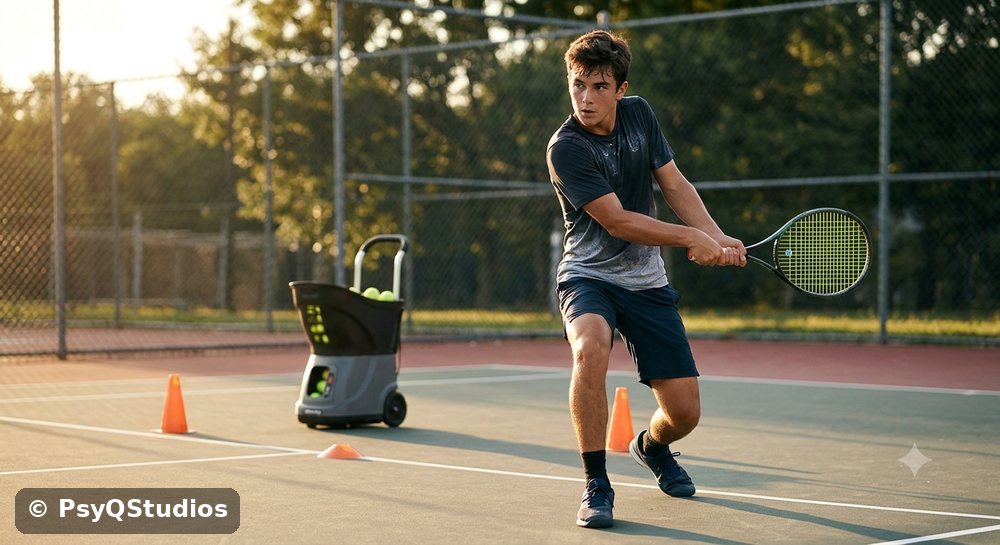
When you train, your focus should be on your side of the net. During practice, you are actively trying to build and refine your skills: your forehand mechanics, your serve placement, your movement patterns, and your emotional control. Sometimes you should also train your problem-solving by practising your attention on the other side of the net.
But when you step out onto the court on match day, the entire mission changes. The goal on match day is to use the skills you developed during training to beat the person on the other side of the net, not to battle yourself. If I am thinking COMPETE, I am thinking about how to use all my skills, tactical tricks, and physical traits to gain the upper hand over my opponent.
If you recall our discussion in Falling Forward, winning or losing itself is not the ultimate objective. Rather, trying to win using the tools you have developed is the key to improving and reaching goals with no ceiling. Focusing purely on the result, regardless of how you achieve it, creates a false sense of success and places a hard ceiling on your growth.
This article directly connects with that principle. To truly progress, you must maintain constant awareness of one fundamental question: WHERE IS MY FOCUS?
Present-tense thinking and the prefrontal cortex
We established in Containing Your Fire that we must remain in a present-tense state of thinking to avoid being overwhelmed by emotions. But if your focus is anchored in the present moment, what specifically should you be focusing on?
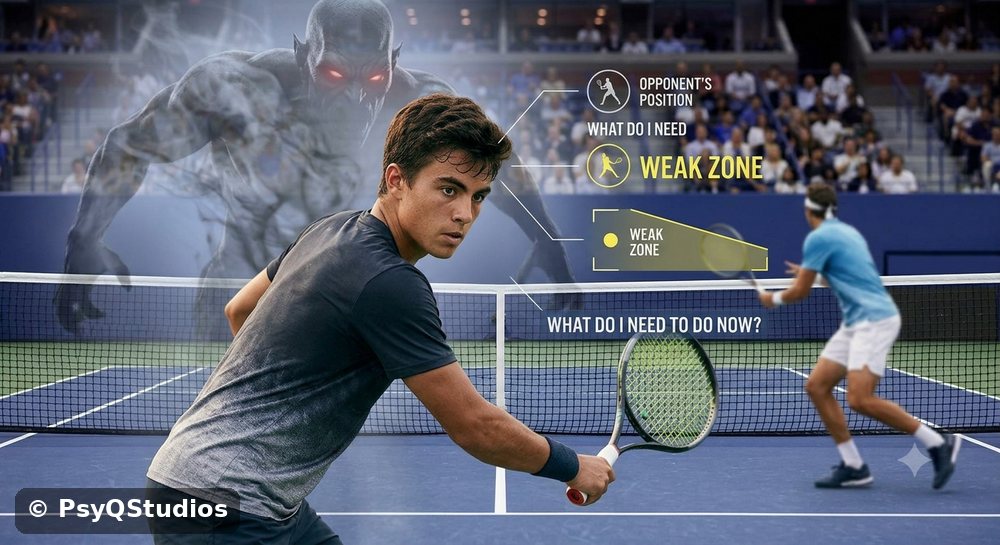
The answer is wonderfully simple: "WHAT DO I NEED TO DO!"
All players, even world champions, go in and out of the present moment. Everyone feels moments of fear, anxiety, or frustration. What separates elite professionals from the rest is their ability to recognise the feeling within seconds, soak it in, let it go, and immediately reset back to the present tense. They instantly return to asking: What do I need to do right now? Professional players call this MINDFULNESS.
The two types of present focus: solutions vs. analysis
It is crucial to understand that simply being in a present mindset is not enough. It matters what you ask yourself once you get there. Most players subtly corrupt the core question. Instead of asking "What do I need to do?", they shift it to "What am I doing wrong?" They become consumed by stroke mechanics, analysing why their serve missed or obsessing over errors instead of seeking outward tactical solutions. You can be entirely in the present moment and still be mistakenly focused on your side of the net.
Your mental objective should never be: "How do I fix my low first-serve percentage?" That is an internal, defensive perspective. Instead, frame it offensively: "How can I raise my first-serve percentage to apply maximum pressure on my opponent?" Focus on the adaptations you need: How can I exploit their weaker backhand? How can I attack the short balls they give me? How can I dictate play into the open court? True present focus looks across the net, converting present-moment awareness into tactical dominance.
Focus on your side (incorrect)
- Asking: "What am I doing wrong?"
- Obsessing over mechanics and technique
- Analysing errors instead of solutions
- Fixating on missed first serves
Focus across the net (correct)
- Asking: "What do I need to do to win?"
- Heightening first-serve percentage to pressure the opponent
- Exploiting the weaker backhand
- Attacking the open court and short balls
If your mind is centred on tactical execution across the net, fear and anxiety naturally recede into secondary background noise. The secret is not trying to eradicate anxiety entirely, but refusing to let negative emotions or internal technical mechanics become the primary thoughts in your head. We want to engage our prefrontal cortex while playing, keeping our cognitive executive functions free to solve tactical problems and exploit our opponent's weaknesses.
Key takeaways
- The scoreboard reality: You don't win by beating yourself. You win by beating the opponent across the net. Shift your attention outward.
- Training vs. matches: Practice is for building your skills on your side of the net. Match day is for deploying those skills against your opponent.
- Solutions over errors: Even in a present mindset, avoid asking "What am I doing wrong?" Ask "What do I need to do to pressure my opponent?"
- The reset routine: Acknowledge negative emotions within seconds, absorb them, let them go, and reset.
- The prefrontal question: Always anchor your mind with: "What do I need to do right now across the net?"
Warum nicht du die wichtigste Person auf dem Platz bist.
Du hast bestimmt schon den Satz gehört, dass du die wichtigste Person auf dem Platz bist. Dass du dein größter Gegner bist und zuerst deine eigenen Ängste und deine Wut besiegen musst, bevor du das Match gewinnen kannst. Du hast Trainer sagen hören „Konzentrier dich auf dein Spiel“, und du hast Trainer und Eltern sagen hören „Mach dir keine Gedanken über den Sieg“.
Ich möchte grundlegend verändern, wie du über diese Sätze denkst.
Erstens: Wenn ein Match vorbei ist, steht auf der Anzeigetafel nicht Johnny schlägt Johnny. Dort steht, dass Johnny Andy geschlagen hat. Du schlägst die Person auf der anderen Seite des Netzes, NICHT DICH SELBST. Für mich ist die Person auf der anderen Seite des Netzes die wichtigste Person auf dem Platz.
Die Falle der nach innen gerichteten Aufmerksamkeit
Ich erkläre dir, was wirklich passiert, wenn du dich nach innen wendest. Wenn du im Match ängstlich, wütend, traurig oder teilnahmslos bist, bedeutet das, dass dein Fokus ganz auf deiner Seite des Netzes gefangen ist.
Dein innerer Dialog wird zu einer endlosen Schleife der Selbstbeschäftigung: „Ich bin wütend, ich bin nervös, ich bin gestresst.“ Dein Fokus ist so sehr damit beschäftigt, deine eigenen Dämonen in Schach zu halten, dass du die eigentliche Aufgabe völlig vergisst: WAS MUSS ICH TUN?
Denk einmal von der anderen Seite: Wenn dein Gegner wütend wird, hast du das Gefühl, die Oberhand zu gewinnen, oder? Du gewinnst Selbstvertrauen, wenn du seine Frustration siehst. Genau dasselbe passiert, wenn du wütend wirst. Du übersiehst, was deine sichtbare Wut für das Selbstvertrauen deines Gegners tut. Und warum übersiehst du das? Weil deine Aufmerksamkeit auf deiner Seite des Netzes festhängt, nicht auf seiner.
Training und Matchtag: zwei verschiedene Arenen
Im Training sollte dein Fokus auf deiner Seite des Netzes liegen. Du baust und verfeinerst aktiv deine Fähigkeiten: deine Vorhandmechanik, deine Aufschlagplatzierung, deine Bewegungsmuster und deine emotionale Kontrolle. Manchmal solltest du auch deine Problemlösefähigkeit trainieren, indem du deine Aufmerksamkeit auf die andere Seite des Netzes übst.
Aber wenn du am Matchtag auf den Platz gehst, ändert sich die Aufgabe komplett. Das Ziel am Matchtag ist, die Fähigkeiten aus dem Training zu nutzen, um die Person auf der anderen Seite des Netzes zu schlagen, nicht um gegen dich selbst zu kämpfen. Wenn ich COMPETE (Wettkämpfen) denke, denke ich daran, wie ich alle meine Fähigkeiten, taktischen Tricks und körperlichen Stärken nutze, um gegen meinen Gegner die Oberhand zu gewinnen.
Wenn du dich an unser Gespräch in Falling Forward erinnerst: Sieg oder Niederlage an sich sind nicht das eigentliche Ziel. Entscheidend ist vielmehr, mit den Werkzeugen zu gewinnen, die du entwickelt hast, um besser zu werden und Ziele ohne Decke zu erreichen. Wer sich nur auf das Ergebnis konzentriert, egal wie es zustande kommt, erzeugt ein falsches Gefühl von Erfolg und setzt seinem Wachstum eine harte Decke.
Dieser Artikel knüpft direkt an dieses Prinzip an. Um wirklich voranzukommen, musst du ständig eine grundlegende Frage im Bewusstsein halten: WO IST MEIN FOKUS?
Denken in der Gegenwart und der präfrontale Kortex
In Containing Your Fire haben wir festgestellt, dass wir im Denken in der Gegenwart bleiben müssen, um nicht von Emotionen überwältigt zu werden. Aber wenn dein Fokus im gegenwärtigen Moment verankert ist, worauf genau sollst du dich dann konzentrieren?
Die Antwort ist wunderbar einfach: „WAS MUSS ICH TUN?“
Alle Spieler, selbst Weltmeister, gehen in den gegenwärtigen Moment hinein und wieder aus ihm heraus. Jeder erlebt Momente von Angst, Nervosität oder Frust. Was Spitzenprofis vom Rest unterscheidet, ist ihre Fähigkeit, das Gefühl innerhalb von Sekunden zu erkennen, es aufzunehmen, loszulassen und sofort in die Gegenwart zurückzukehren. Sie fragen sofort wieder: Was muss ich jetzt tun? Profispieler nennen das ACHTSAMKEIT (Mindfulness).
Die zwei Arten von Gegenwartsfokus: Lösungen oder Analyse
Es ist entscheidend zu verstehen, dass es nicht reicht, einfach in der Gegenwart zu sein. Es kommt darauf an, was du dich fragst, wenn du dort bist. Die meisten Spieler verdrehen die Kernfrage unmerklich. Statt zu fragen „Was muss ich tun?“, fragen sie „Was mache ich falsch?“ Sie verlieren sich in der Schlagtechnik, analysieren, warum der Aufschlag danebenging, oder grübeln über Fehler, statt nach taktischen Lösungen nach außen zu suchen. Du kannst voll im gegenwärtigen Moment sein und trotzdem fälschlich auf deiner Seite des Netzes fokussiert bleiben.
Dein mentales Ziel sollte nie lauten: „Wie behebe ich meine niedrige Quote beim ersten Aufschlag?“ Das ist eine nach innen gerichtete, defensive Sichtweise. Formuliere es stattdessen offensiv: „Wie kann ich meine Quote beim ersten Aufschlag erhöhen, um maximalen Druck auf meinen Gegner auszuüben?“ Konzentriere dich auf die Anpassungen, die du brauchst: Wie kann ich seine schwächere Rückhand ausnutzen? Wie kann ich die kurzen Bälle angreifen, die er mir gibt? Wie kann ich das Spiel in den freien Platz diktieren? Echter Gegenwartsfokus schaut über das Netz und verwandelt Achtsamkeit im Moment in taktische Überlegenheit.
Fokus auf deiner Seite (falsch)
- Fragen: „Was mache ich falsch?“
- Grübeln über Mechanik und Technik
- Fehler analysieren statt Lösungen suchen
- Fixiert auf verfehlte erste Aufschläge
Fokus auf der anderen Netzseite (richtig)
- Fragen: „Was muss ich tun, um zu gewinnen?“
- Quote beim ersten Aufschlag erhöhen, um den Gegner unter Druck zu setzen
- Die schwächere Rückhand ausnutzen
- Den freien Platz und kurze Bälle angreifen
Wenn dein Kopf bei der taktischen Umsetzung auf der anderen Netzseite ist, treten Angst und Nervosität von selbst in den Hintergrund und werden zu Nebengeräuschen. Das Geheimnis ist nicht, Angst ganz zu beseitigen, sondern negativen Emotionen oder innerer Technikanalyse nicht zu erlauben, zu deinen Hauptgedanken zu werden. Wir wollen im Spiel unseren präfrontalen Kortex einsetzen und unsere exekutiven Funktionen frei halten, um taktische Probleme zu lösen und die Schwächen des Gegners auszunutzen.
Die wichtigsten Erkenntnisse
- Die Realität der Anzeigetafel: Du gewinnst nicht, indem du dich selbst schlägst. Du gewinnst, indem du den Gegner auf der anderen Netzseite schlägst. Richte deine Aufmerksamkeit nach außen.
- Training und Matches: Das Training dient dazu, deine Fähigkeiten auf deiner Seite des Netzes aufzubauen. Der Matchtag dient dazu, diese Fähigkeiten gegen deinen Gegner einzusetzen.
- Lösungen statt Fehler: Auch im Gegenwartsmodus solltest du nicht fragen „Was mache ich falsch?“ Frage: „Was muss ich tun, um meinen Gegner unter Druck zu setzen?“
- Die Reset-Routine: Erkenne negative Emotionen innerhalb von Sekunden, nimm sie auf, lass sie los und setze dich zurück.
- Die präfrontale Frage: Verankere deinen Kopf immer mit: „Was muss ich jetzt tun, auf der anderen Netzseite?“