
Containing Your FireContaining Your Fire: Das Feuer in dir unter Kontrolle halten
We've all heard that getting angry makes you play worse, or that getting nervous or playing with fear isn't good for you. These are all true statements. In this article we're going to dig a little deeper and explore what exactly happens inside your brain, what emotions do to your thinking process, and how they influence your performance.
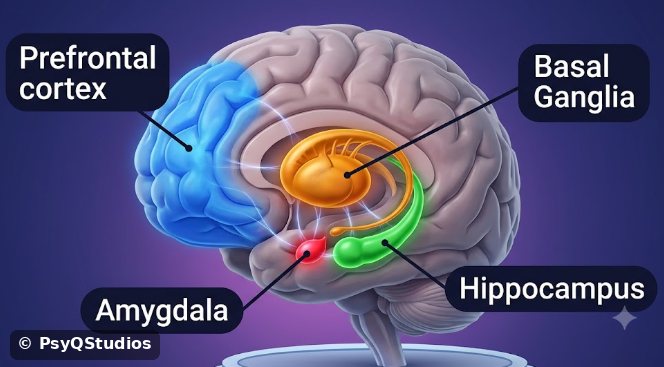
The image below illustrates the brain and the four areas we will be discussing: the prefrontal cortex, the amygdala, the hippocampus, and the basal ganglia.
Let's have a closer look at the function of each of these areas.
Prefrontal cortex
It's the part of the brain at the front, behind your forehead. It controls executive functions, which means it is the command centre of the brain and is responsible for higher thinking. It processes game strategy, predicts where an opponent is likely to hit based on their body language and shot selection (for example, choosing a drop shot over a cross-court forehand), and helps regulate emotional focus under pressure.
Amygdala
It's found almost in the middle of your brain, between the two halves. Think of the amygdala as the security alarm system: its job is to keep you safe.
Right now, when you're playing, you're using 100% of your prefrontal cortex. Everything is going well, you're making good decisions, and your mind is free to think about what it needs to do. As the match progresses, you make three unforced errors, and a little trigger inside your brain makes you perceive the start of an emotional build-up, whether it be fear, anger, stress, or many other emotions. This is your amygdala activating.
Our brain's main function is survival, and our brains are always looking at the state of things. When you make three or so mistakes, your brain perceives a threat, and the amygdala activates. Suddenly, you're using less of your prefrontal cortex (let's say 80%, with 20% of it now offline). You make a few more mistakes, you feel the match slipping, and the amygdala activates even more, until your prefrontal cortex is completely bypassed and you're not using rational thinking to make decisions anymore.
Hippocampus
Found deep in the brain, next to the amygdala, it is the emotional memory bank. It ties emotions to specific past experiences, like remembering the frustration of losing to a specific playing style or the confidence of a past victory. In this scenario, the hippocampus is remembering all the frustrations you've felt in the past.
Basal ganglia
A group of nerves in the middle of the brain, responsible for creating smooth, automatic movements and habits. It's everything you have trained over and over, a kind of "auto-pilot". But when it is influenced by the amygdala, instead of executing the smooth automatic movement, it executes your automatic "fight-or-flight" response.
Do you see how these four areas of the brain work together and influence each other? The image below gives a summary of what we've just explained.
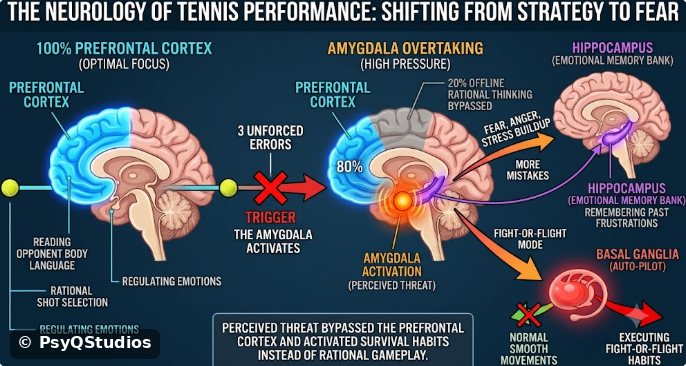
As we can see, from here it's very tough to get back to a place of playing with an activated prefrontal cortex.
The contained fire
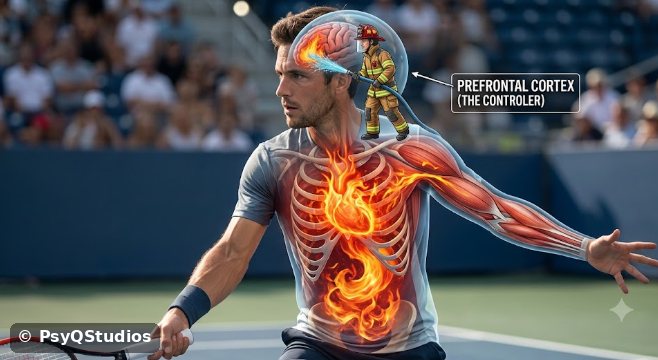
Bringing out the best in yourself during a tennis match is like a firefighter lighting a contained fire. Powerful, strong, determined, but contained. You have to play with this fire inside you so that you have a good chance of success, but your prefrontal cortex has to contain the fire before outside elements such as mistakes, the sun, the wind, the opponent, or the circumstances turn that controlled fire into a wildfire.
Emotions and time
The next thing to consider is emotions. What are emotions? To explain it in simple terms, emotions are short-term, immediate reactions to a specific situation. Yes, an emotion can stay with you, but you can also just as easily make the conscious decision to let it go.
Here's what's truly happening: all emotions have a past or a future to them. You can say the emotion is caused by an experience in the past that produced the same emotion, so there is a memory of that emotion connected to the experience. On the other hand, you can feel an emotion for what might happen in the future.
For example, anger: you are angry about the mistake you MADE (past tense), or most likely about a few you made in the past. What about anxiety? I am anxious because of what could possibly happen in the future. Happiness? Something that happened. Excitement? Something that could happen. Every emotion has a tense to it: past or future.
Past tense
- Anger
- Frustration
- Sadness
- Regret
- Nostalgia
- Shame
- Resentment
- Remorse
- Guilt
- Grief
- Bitterness
- Longing
- Memories
- Reflection
- Cherishing
- Forgiveness
- Appreciation
- Acceptance
Future tense
- Excitement
- Hope
- Fear
- Anxiety
- Anticipation
- Appraisal
- Worry
- Enthusiasm
- Curiosity
- Doubt
- Nervousness
- Optimism
- Uncertainty
- Expectation
- Planning
- Dread
- Wonder
- Aspiration
- Relief
- Trepidation
- Inspiration
In the middle of these two tenses lies the present tense. Have you heard coaches say "stay in the moment" or "think one point at a time"? What they mean is that when you are in the past or the future, your amygdala starts to activate. When you stay in the present tense, you stay focused on what you need to do. If you have to study for a test, you can't focus if you're angry, excited about something in the near future, or afraid. Only when you're fully in the present tense can you be level-headed and grounded.
Past tense
- Anger
- Frustration
- Sadness
- Regret
- Nostalgia
- Shame
- Resentment
- Remorse
- Acceptance
- Guilt
Present tense
Future tense
- Excitement
- Fear
- Anticipation
- Worry
- Dread
- Optimism
- Uncertainty
- Expectation
- Aspiration
- Trepidation
- Inspiration
I mentioned earlier that the amygdala is the brain's security alarm system. This means the human brain is designed for survival. Thousands of years ago, it was truly about survival: cavemen had to hunt to feed their families or fight off bears to protect them. That was the world of competitiveness they lived in. As time went by, sport was created to be competitive, but in a safer environment. Our brains still perceive the same threat, because the hormones and "messengers" (neurotransmitters) released by the body are the same, so the brain reads it as the same danger. What is really noteworthy is that professional players have realised there is no real threat here. It is merely our bodies that perceive one.
The trick is awareness
So the question is: how do I prevent my emotional centre (the amygdala) from activating? How do I keep competing using my prefrontal cortex? How do I stay, or quickly bring myself back to, a state of awareness? The trick is that word: AWARENESS.
Professionals have tirelessly practised this. When you go onto the court, write down what you want to focus on today. Write down three things, with the date and a tick box next to each.
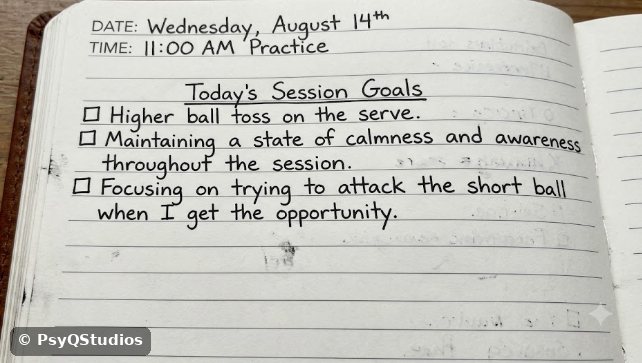
Now, throughout the session, stay aware of your focus. Where is your focus right now? Is it still on your goals? During water breaks, take out your diary and do a cross-check: am I still on track? This will significantly help you train your awareness of being in the present.
Something you can do in both practice and matches is to use the word WIN: "What's important now?" Asking yourself this after every point helps you refocus on the present moment. It sounds easy, but you'll see it's tougher than it sounds, in the beginning when things are in control, as well as when things are out of control.
Novak Djokovic talks about the storm that is going on inside him. This simply means that, like you and me, he constantly moves in and out of the present. But he has the ability to stay in the future or the past for a few seconds before bringing it back to the centre, back to the present tense.
Wir alle haben gehört, dass man schlechter spielt, wenn man wütend wird, und dass Nervosität oder Angst nicht gut für die Leistung sind. Das stimmt alles. In diesem Artikel gehen wir etwas tiefer und schauen uns an, was genau in deinem Gehirn passiert, was Emotionen mit deinem Denken machen und wie sie deine Leistung beeinflussen.
Das Bild unten zeigt das Gehirn und die vier Bereiche, über die wir sprechen: den präfrontalen Kortex, die Amygdala, den Hippocampus und die Basalganglien.
Schauen wir uns die Aufgabe jedes dieser Bereiche genauer an.
Präfrontaler Kortex
Das ist der vorderste Teil des Gehirns, hinter deiner Stirn. Er steuert die exekutiven Funktionen, das heißt, er ist die Kommandozentrale des Gehirns und für das höhere Denken zuständig. Er verarbeitet die Spielstrategie, sagt anhand von Körpersprache und Schlagauswahl voraus, wohin der Gegner wahrscheinlich spielt (zum Beispiel einen Stopp statt einer Cross-Vorhand), und hilft, den emotionalen Fokus unter Druck zu regulieren.
Amygdala
Sie liegt fast in der Mitte deines Gehirns, zwischen den beiden Hälften. Stell dir die Amygdala als Alarmanlage vor: Ihre Aufgabe ist es, dich zu schützen.
Gerade jetzt, während du spielst, nutzt du 100 % deines präfrontalen Kortex. Alles läuft gut, du triffst gute Entscheidungen, und dein Kopf ist frei, um zu denken, was zu tun ist. Im Laufe des Matches machst du drei leichte Fehler, und ein kleiner Auslöser in deinem Gehirn lässt dich den Beginn eines emotionalen Aufbaus wahrnehmen, sei es Angst, Wut, Stress oder viele andere Emotionen. Das ist deine Amygdala, die sich aktiviert.
Die Hauptaufgabe unseres Gehirns ist das Überleben, und es beobachtet ständig die Lage. Wenn du etwa drei Fehler machst, nimmt dein Gehirn eine Bedrohung wahr, und die Amygdala wird aktiv. Plötzlich nutzt du weniger von deinem präfrontalen Kortex (sagen wir 80 %, während 20 % nun offline sind). Du machst ein paar weitere Fehler, spürst, wie dir das Match entgleitet, und die Amygdala wird noch aktiver, bis dein präfrontaler Kortex komplett umgangen wird und du nicht mehr rational entscheidest.
Hippocampus
Er liegt tief im Gehirn, neben der Amygdala, und ist die emotionale Gedächtnisbank. Er verknüpft Emotionen mit bestimmten vergangenen Erfahrungen, etwa der Frustration, gegen einen bestimmten Spielstil verloren zu haben, oder dem Selbstvertrauen eines früheren Siegs. In diesem Szenario erinnert sich der Hippocampus an alle Frustrationen, die du in der Vergangenheit erlebt hast.
Basalganglien
Eine Gruppe von Nervenzellen in der Mitte des Gehirns, zuständig für flüssige, automatische Bewegungen und Gewohnheiten. Es ist alles, was du immer wieder trainiert hast, eine Art „Autopilot“. Wird er aber von der Amygdala beeinflusst, führt er nicht mehr die flüssige automatische Bewegung aus, sondern deine automatische „Kampf-oder-Flucht“-Reaktion.
Siehst du, wie diese vier Bereiche des Gehirns zusammenarbeiten und sich gegenseitig beeinflussen? Das Bild unten fasst zusammen, was wir gerade erklärt haben.
Wie du siehst, ist es von hier aus sehr schwer, wieder zu einem aktiven präfrontalen Kortex zurückzufinden.
Das kontrollierte Feuer
Dein bestes Spiel im Match abzurufen ist wie bei einem Feuerwehrmann, der ein kontrolliertes Feuer entzündet. Kraftvoll, stark, entschlossen, aber unter Kontrolle. Du musst mit diesem Feuer in dir spielen, um eine gute Chance auf Erfolg zu haben, doch dein präfrontaler Kortex muss das Feuer unter Kontrolle halten, bevor äußere Einflüsse wie Fehler, Sonne, Wind, der Gegner oder die Umstände aus diesem kontrollierten Feuer einen Flächenbrand machen.
Emotionen und Zeit
Als Nächstes geht es um Emotionen. Was sind Emotionen? Einfach erklärt: Emotionen sind kurzfristige, unmittelbare Reaktionen auf eine bestimmte Situation. Ja, eine Emotion kann dich begleiten, aber du kannst genauso gut bewusst entscheiden, sie loszulassen.
Was wirklich passiert: Alle Emotionen haben eine Vergangenheit oder eine Zukunft. Man kann sagen, die Emotion entsteht durch eine Erfahrung in der Vergangenheit, die dieselbe Emotion ausgelöst hat, es gibt also eine Erinnerung an diese Emotion, die mit der Erfahrung verbunden ist. Man kann aber auch eine Emotion für etwas empfinden, das in der Zukunft passieren könnte.
Zum Beispiel Wut: Du bist wütend über den Fehler, den du GEMACHT hast (Vergangenheit), oder meistens über ein paar Fehler, die du in der Vergangenheit gemacht hast. Und Angst? Ich habe Angst vor dem, was in der Zukunft passieren könnte. Glück? Etwas, das geschehen ist. Aufregung? Etwas, das geschehen könnte. Jede Emotion hat eine Zeitform: Vergangenheit oder Zukunft.
Vergangenheit
- Wut
- Frustration
- Traurigkeit
- Bedauern
- Nostalgie
- Scham
- Groll
- Reue
- Schuld
- Trauer
- Bitterkeit
- Sehnsucht
- Erinnerungen
- Reflexion
- Wertschätzung
- Vergebung
- Dankbarkeit
- Akzeptanz
Zukunft
- Aufregung
- Hoffnung
- Angst
- Besorgnis
- Vorfreude
- Einschätzung
- Sorge
- Begeisterung
- Neugier
- Zweifel
- Nervosität
- Optimismus
- Ungewissheit
- Erwartung
- Planung
- Grauen
- Staunen
- Streben
- Erleichterung
- Beklommenheit
- Inspiration
Zwischen diesen beiden Zeitformen liegt die Gegenwart. Hast du schon einmal Trainer sagen hören: „Bleib im Moment“ oder „Denk Punkt für Punkt“? Gemeint ist: Wenn du in der Vergangenheit oder in der Zukunft bist, beginnt deine Amygdala sich zu aktivieren. Wenn du in der Gegenwart bleibst, bleibst du bei dem, was du tun musst. Wenn du für eine Prüfung lernen musst, kannst du dich nicht konzentrieren, wenn du wütend bist, dich auf etwas in naher Zukunft freust oder Angst hast. Nur wenn du ganz in der Gegenwart bist, kannst du besonnen und geerdet sein.
Vergangenheit
- Wut
- Frustration
- Traurigkeit
- Bedauern
- Nostalgie
- Scham
- Groll
- Reue
- Akzeptanz
- Schuld
Gegenwart
Zukunft
- Aufregung
- Angst
- Vorfreude
- Sorge
- Grauen
- Optimismus
- Ungewissheit
- Erwartung
- Streben
- Beklommenheit
- Inspiration
Ich habe vorhin gesagt, dass die Amygdala die Alarmanlage des Gehirns ist. Das heißt: Das menschliche Gehirn ist auf Überleben ausgelegt. Vor Tausenden von Jahren ging es wirklich ums Überleben: Höhlenmenschen mussten jagen, um ihre Familien zu ernähren, oder Bären abwehren, um sie zu schützen. Das war die Welt des Wettbewerbs, in der sie lebten. Mit der Zeit entstand der Sport als Wettkampf in einer sichereren Umgebung. Unser Gehirn nimmt dieselbe Bedrohung trotzdem wahr, weil die Hormone und „Botenstoffe“ (Neurotransmitter), die der Körper ausschüttet, dieselben sind, und das Gehirn sie deshalb als dieselbe Gefahr liest. Bemerkenswert ist, dass Profispieler erkannt haben, dass hier keine echte Bedrohung besteht. Es ist lediglich unser Körper, der eine wahrnimmt.
Der Trick heißt Achtsamkeit
Die Frage lautet also: Wie verhindere ich, dass sich mein emotionales Zentrum (die Amygdala) aktiviert? Wie spiele ich weiter mit meinem präfrontalen Kortex? Wie bleibe ich in einem Zustand der Achtsamkeit oder komme schnell dorthin zurück? Der Trick ist genau dieses Wort: ACHTSAMKEIT (Awareness).
Profis haben das unermüdlich geübt. Wenn du auf den Platz gehst, schreibe auf, worauf du dich heute konzentrieren willst. Schreibe drei Dinge auf, mit Datum und einem Kästchen zum Abhaken neben jedem.
Bleibe während der ganzen Einheit achtsam für deinen Fokus. Wo ist dein Fokus gerade? Ist er noch bei deinen Zielen? Hol in den Trinkpausen dein Tagebuch heraus und prüfe nach: Bin ich noch auf Kurs? Das trainiert deine Achtsamkeit für den gegenwärtigen Moment erheblich.
Etwas, das du im Training und im Match nutzen kannst, ist das Wort WIN: „What's important now?“, also „Was ist jetzt wichtig?“ Wenn du dir diese Frage nach jedem Punkt stellst, holst du deinen Kopf in den gegenwärtigen Moment zurück. Das klingt einfach, aber du wirst merken, dass es schwerer ist, als es klingt, am Anfang, wenn alles unter Kontrolle ist, genauso wie wenn nichts mehr unter Kontrolle ist.
Novak Djokovic spricht über den Sturm, der in ihm tobt. Das bedeutet einfach, dass er sich, genau wie du und ich, ständig in die Gegenwart hinein und wieder aus ihr heraus bewegt. Aber er kann ein paar Sekunden in der Zukunft oder Vergangenheit bleiben, bevor er sich zurück in die Mitte holt, zurück in die Gegenwart.