
Falling ForwardFalling Forward: Nach vorn fallen
You hear it everywhere in sports: on TV, in post-match interviews, and from your coaches. "Trust the process." "Believe in the process." "Stay with the process."
If you were to ask five different players on your team what "the process" actually means, you would probably get five very confused answers:
- "Uhh… showing up to practice on time?"
- "Doing extra fitness when coach tells me to?"
- "Running until my legs fall off?"
- Or the most common answer: "Honestly… I have no idea."
Let's clear up the mystery once and for all.
Playing the result vs. playing the game
Let's be honest for a second. Many coaches say, "Don't worry about winning or losing," or "Winning doesn't matter!" But let's be real: the person who said winning doesn't matter probably just lost!
Winning is fun. Winning does matter. It's important to try and win every time you step on the court. But what is most important is that you try to win using the tools, strategies, and skills you have built in "the process".
The big mistake isn't wanting to win. The mistake is becoming so obsessed with the final score that you forget how to play the actual game.
- Focusing on the result: turns your entire match into a high-stress test. If you miss a shot, you panic about the score, start playing scared, and forget everything you practised.
- Focusing on progress: focuses on the big picture, the journey of becoming the best player you can be.
The four match scenarios: where are your feet?
Imagine your journey as a path leading from where you are today to your big dream. Every match you play puts you into one of four scenarios.
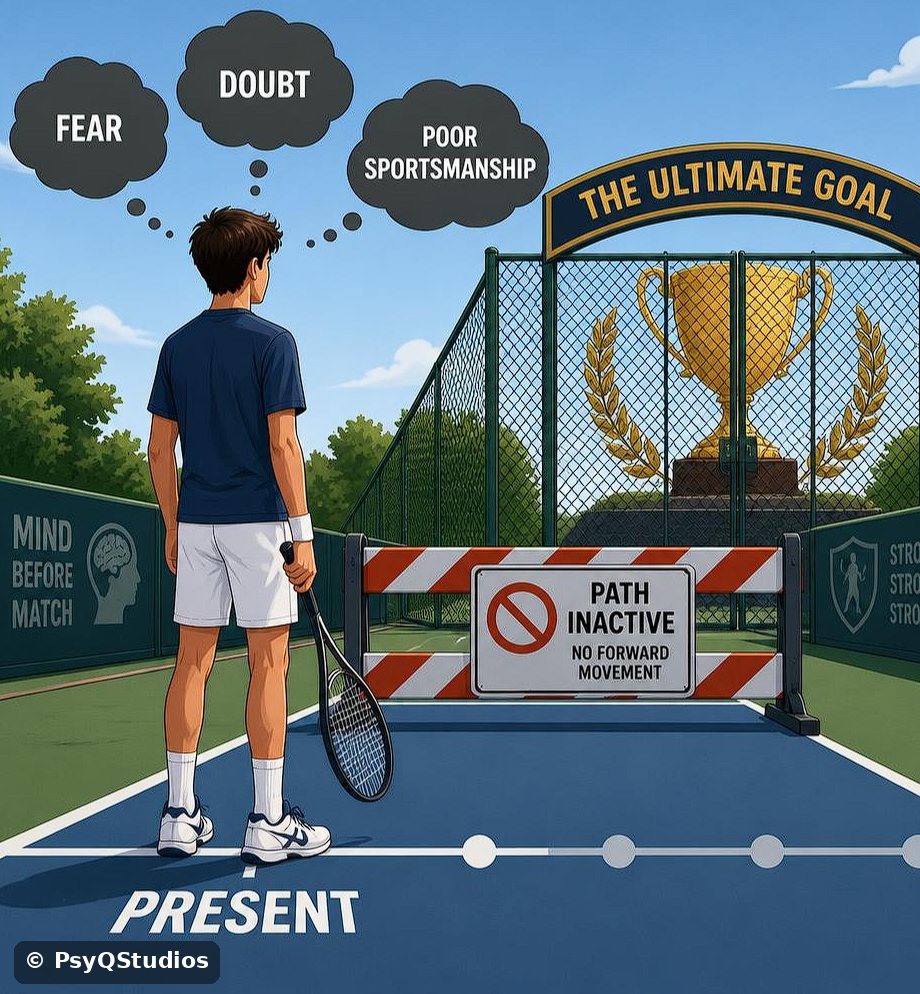
Scenario 1: The result-focused win
What happens: You won the match, but you were terrified of losing. You played safe, pushed the ball, threw tantrums when things went wrong, and just waited for your opponent to make mistakes.
Did you move closer to your goal? Nope.
Why? You got a point on the scoreboard, but your actual skill level didn't grow at all. You played "not to lose" instead of playing to improve. Your feet stayed in the exact same spot on your timeline.
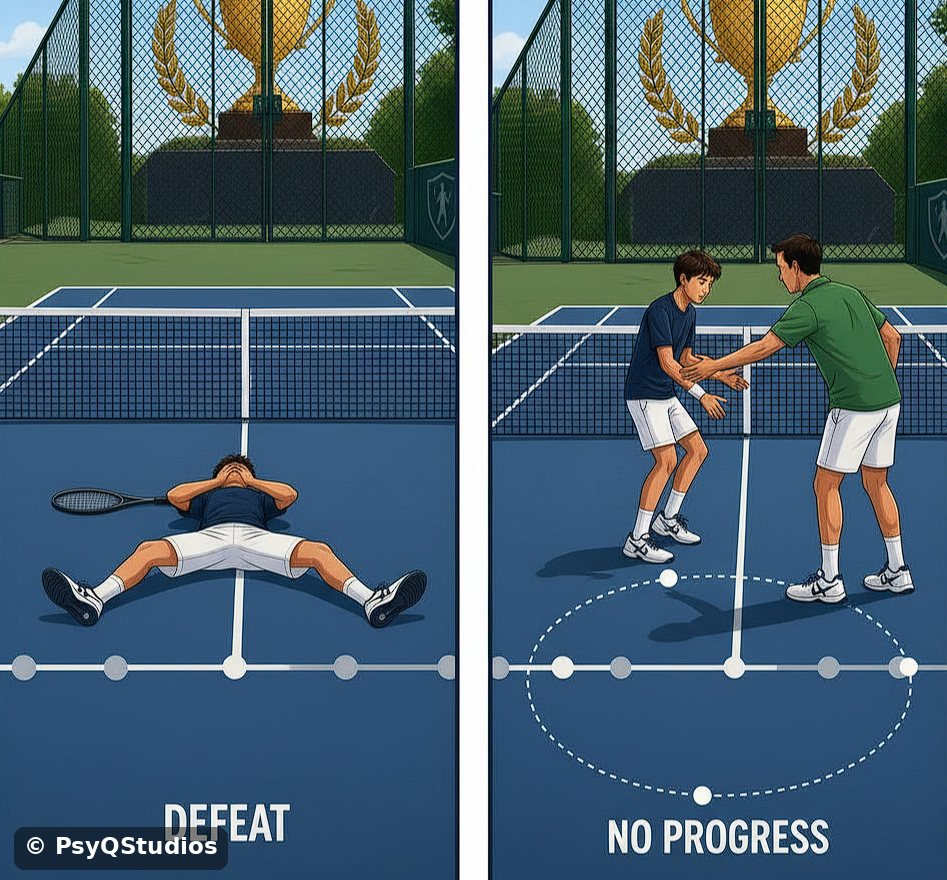
Scenario 2: The result-focused loss
What happens: You lost the match while completely stressed out about the score. You got angry, gave up early, or let fear take over your game.
The outcome: You fell, and you fell backward.
The next morning: You lie down on the court on your back. When your coach reaches out a hand to help you up, your feet are in the exact same spot where you started before the match. Zero growth happened.
Scenario 3: The process-focused win
What happens: You won the match, AND you played the right way! You trusted your training, went for your shots under pressure, stayed calm, and executed your strategy.
Did you move closer to your goal? Yes!
Why? The win was just a bonus. The real prize was that you proved your new skills work under pressure. You take a big, confident step forward toward your goal.
Scenario 4: The process-focused loss, "falling forward"
What happens: This is where the magic happens. You lost the match, BUT you gave 100% effort to apply what you've been working on in practice. You took smart risks, stayed mentally tough, and fought for every point using the right strategy.
The outcome: You fell, but you FELL FORWARD.
The next morning: You lie on the court on your stomach, reaching forward toward your goal. When your coach extends a hand to pull you up, you reach out, pull yourself up, and your feet naturally land a step ahead of where you started!
You lost the match, but you still upgraded your game.
The mindset matrix
This matrix shows how your mindset during a match determines whether you make real progress toward your goals.
| Winning | Losing | |
|---|---|---|
| Focused on result | No progress Result-focused win: pushed the ball, played with fear, skills stayed the same. | No progress Result-focused loss: fell backward, tantrums and frustration, no growth. |
| Focused on process | Progress Process-focused win: trusted your training, tried new skills, grew stronger. | Progress Process-focused loss: fell forward, learned from mistakes, stood up a step ahead. |
The golden rule: don't build a false ceiling
Chasing easy tournament wins or playing safe just to get a higher ranking creates a false ceiling.
A trophy or a shiny ranking number doesn't mean much if your actual level of play hasn't improved. If you step up to higher competition without developing your game, that false ceiling will crash down fast.
Focus on your progress, trust your work, and don't be afraid to take hits along the way.
Du hörst es überall im Sport: im Fernsehen, in Interviews nach dem Match und von deinen Trainern. „Trust the process.“ „Believe in the process.“ „Stay with the process.“
Wenn du fünf verschiedene Spieler deines Teams fragen würdest, was „der Prozess“ eigentlich ist, bekämst du wahrscheinlich fünf ziemlich ratlose Antworten:
- „Äh … pünktlich zum Training kommen?“
- „Zusätzliche Fitness machen, wenn der Trainer es sagt?“
- „Rennen, bis die Beine nicht mehr können?“
- Oder die häufigste Antwort: „Ehrlich gesagt … keine Ahnung.“
Lass uns dieses Rätsel ein für alle Mal lösen.
Das Ergebnis spielen oder das Spiel spielen
Seien wir ehrlich. Viele Trainer sagen: „Mach dir keine Gedanken über Sieg oder Niederlage“ oder „Gewinnen ist nicht wichtig!“ Aber seien wir realistisch: Wer sagt, dass Gewinnen nicht wichtig ist, hat wahrscheinlich gerade verloren!
Gewinnen macht Spaß. Gewinnen ist wichtig. Du solltest jedes Mal versuchen zu gewinnen, wenn du auf den Platz gehst. Entscheidend ist aber, dass du versuchst, mit den Werkzeugen, Strategien und Fähigkeiten zu gewinnen, die du im „Prozess“ aufgebaut hast.
Der große Fehler ist nicht, gewinnen zu wollen. Der Fehler ist, so besessen vom Endergebnis zu sein, dass du vergisst, wie man das eigentliche Spiel spielt.
- Fokus auf das Ergebnis: macht aus deinem ganzen Match einen Stresstest. Wenn du einen Schlag verfehlst, gerätst du wegen des Spielstands in Panik, spielst ängstlich und vergisst alles, was du geübt hast.
- Fokus auf Fortschritt: richtet den Blick auf das große Ganze, auf den Weg, die bestmögliche Spielerin oder der bestmögliche Spieler zu werden.
Die vier Matchszenarien: Wo stehen deine Füße?
Stell dir deinen Weg als Pfad vor, der von deinem heutigen Stand zu deinem großen Traum führt. Jedes Match bringt dich in eines von vier Szenarien.
Szenario 1: Der ergebnisfixierte Sieg
Was passiert: Du hast das Match gewonnen, hattest aber schreckliche Angst zu verlieren. Du hast sicher gespielt, den Ball nur hinübergeschoben, Wutanfälle bekommen, wenn etwas schiefging, und einfach darauf gewartet, dass dein Gegner Fehler macht.
Bist du deinem Ziel nähergekommen? Nein.
Warum? Du hast einen Punkt auf der Anzeigetafel, aber dein tatsächliches Können ist kein bisschen gewachsen. Du hast gespielt, um nicht zu verlieren, statt zu spielen, um besser zu werden. Deine Füße stehen auf deiner Zeitleiste an genau derselben Stelle.
Szenario 2: Die ergebnisfixierte Niederlage
Was passiert: Du hast das Match verloren und warst dabei völlig gestresst wegen des Ergebnisses. Du wurdest wütend, hast früh aufgegeben oder dich von der Angst dein Spiel übernehmen lassen.
Das Ergebnis: Du bist gefallen, und zwar rückwärts.
Am nächsten Morgen: Du liegst auf dem Rücken auf dem Platz. Wenn dein Trainer dir die Hand reicht, um dich hochzuziehen, stehen deine Füße genau dort, wo sie vor dem Match standen. Es gab keinerlei Wachstum.
Szenario 3: Der prozessfokussierte Sieg
Was passiert: Du hast das Match gewonnen UND richtig gespielt! Du hast deinem Training vertraut, unter Druck deine Schläge gespielt, ruhig geblieben und deine Strategie umgesetzt.
Bist du deinem Ziel nähergekommen? Ja!
Warum? Der Sieg war nur ein Bonus. Der eigentliche Gewinn ist der Beweis, dass deine neuen Fähigkeiten unter Druck funktionieren. Du machst einen großen, selbstbewussten Schritt auf dein Ziel zu.
Szenario 4: Die prozessfokussierte Niederlage, „Falling Forward“
Was passiert: Hier geschieht die Magie. Du hast das Match verloren, ABER du hast 100 % gegeben, um umzusetzen, woran du im Training gearbeitet hast. Du bist kluge Risiken eingegangen, mental stark geblieben und hast mit der richtigen Strategie um jeden Punkt gekämpft.
Das Ergebnis: Du bist gefallen, aber du bist NACH VORN gefallen.
Am nächsten Morgen: Du liegst auf dem Bauch auf dem Platz und streckst dich in Richtung deines Ziels. Wenn dein Trainer dir die Hand reicht, greifst du zu, ziehst dich hoch, und deine Füße landen ganz von selbst einen Schritt vor deinem Ausgangspunkt!
Du hast das Match verloren, aber trotzdem dein Spiel verbessert.
Die Mindset-Matrix
Diese Matrix zeigt, wie deine Einstellung während eines Matches darüber entscheidet, ob du echte Fortschritte in Richtung deiner Ziele machst.
| Gewinnen | Verlieren | |
|---|---|---|
| Fokus auf das Ergebnis | Kein Fortschritt Ergebnisfixierter Sieg: den Ball hinübergeschoben, mit Angst gespielt, Fähigkeiten blieben gleich. | Kein Fortschritt Ergebnisfixierte Niederlage: rückwärts gefallen, Wutanfälle und Frust, kein Wachstum. |
| Fokus auf den Prozess | Fortschritt Prozessfokussierter Sieg: dem Training vertraut, Neues probiert, stärker geworden. | Fortschritt Prozessfokussierte Niederlage: nach vorn gefallen, aus Fehlern gelernt, einen Schritt weiter aufgestanden. |
Die goldene Regel: Baue keine falsche Decke
Wer leichte Turniersiege jagt oder nur sicher spielt, um ein besseres Ranking zu bekommen, baut sich eine falsche Decke.
Ein Pokal oder eine glänzende Ranglistenposition bedeutet wenig, wenn sich dein tatsächliches Spielniveau nicht verbessert hat. Wenn du auf höhere Konkurrenz triffst, ohne dein Spiel entwickelt zu haben, stürzt diese falsche Decke schnell ein.
Konzentriere dich auf deinen Fortschritt, vertraue deiner Arbeit und hab keine Angst, auf dem Weg ein paar Treffer einzustecken.